
For commercial agents growing their production ·
The Lease Expiration Wave Is Here. How Commercial Agents Turn It Into a Pipeline
By Eleanor Curry and Michelle Johnson Lundy, CRE Pros

Commercial lease expirations are the most predictable source of business in this industry, and over the next two years there will be more of them than most agents have a system to handle. CompStak estimates that more than 32 percent of all office leases expire between the second quarter of 2026 and the end of 2028, which is roughly one in three office tenants deciding whether to renew, relocate, expand or shrink inside a single window.
If you already work in commercial and you want to grow your production, this is the opportunity to build around. The agents who win the next two years will not be the ones with the best spreadsheets. They will be the ones who knew when each lease ended and had a relationship with the tenant before the landlord's renewal letter arrived.
Why is this lease expiration cycle different?
This cycle is different because tenants are walking back into a changed market, and they are being told to start earlier. Quality space is tighter, older space is cheaper to negotiate, and the window for a good deal is narrowing.
In Houston, Newmark found that Class A buildings captured 65.5 percent of third-quarter office leasing, while Class B asking rents climbed to a record $23.71 per square foot. Class A means the newest, best-located and best-amenitized buildings in a market, and Class B means older buildings that are still functional but a step down in quality and price.
CBRE's midyear outlook for Houston expects lease expirations in older space to become the main driver of office demand heading into 2027. It also advises tenants with approaching expirations to start weighing renewal and relocation earlier than usual, because the negotiating window is narrowing.
Read that last point from the tenant's side. The tenant is being told to start early, and the only question is who helps them do it.
How do you build a lease expiration calendar?
You build it by recording every lease you can learn about, sorting it by the date the tenant has to decide, and attaching a reason to call. Here is the system, step by step.
- Start with the deals you have already done. Every lease you have touched has an expiration date, and every one of those tenants is a client you can serve again. Put each date into your CRM with a reminder well over a year ahead, because for a tenant of any real size, a year out is already late.
- Add the buildings in your submarket. Property managers, building directories and the tenants themselves will tell you more than you expect when you ask respectfully. If you have access to a commercial database, use it to fill the gaps, but treat what you learn in conversation as the more reliable source.
- Sort by decision date rather than expiration date. The decision date is when the tenant must commit to renewing or moving, and it usually comes well before the lease ends once you account for space planning, build-out time and any notice period written into the lease.
- Track the triggers. A hiring announcement, a new contract, a merger, a second location, or a company quietly putting space on the sublease market each gives you a reason to call that has nothing to do with selling. Sublease space is space a tenant rents out to someone else for the rest of its own lease term, and it often signals a company that is shrinking or moving.
To make it usable, keep one line per tenant with these columns.
| Tenant | Building and suite | Size (square feet) | Lease expiration | Decision date | Trigger or note | Next touch |
|---|---|---|---|---|---|---|
| Example: regional engineering firm | 1200 Example Blvd, Suite 400 | 8,500 | June 2028 | June 2027 | Hired 20 people this year | Call in January |
What should you bring to a tenant eighteen months before expiration?
Bring market information they do not have, so the call is useful to them rather than a request for business. In Houston right now, that means where rents are rising, where they are falling, and what landlords are giving away to keep tenants.
Over the five years through the third quarter, Newmark measured asking-rent growth of 22.0 percent in the FM 1960/249 corridor and 20.8 percent in The Woodlands, while Greenway Plaza fell 2.0 percent and Westchase fell 5.9 percent.
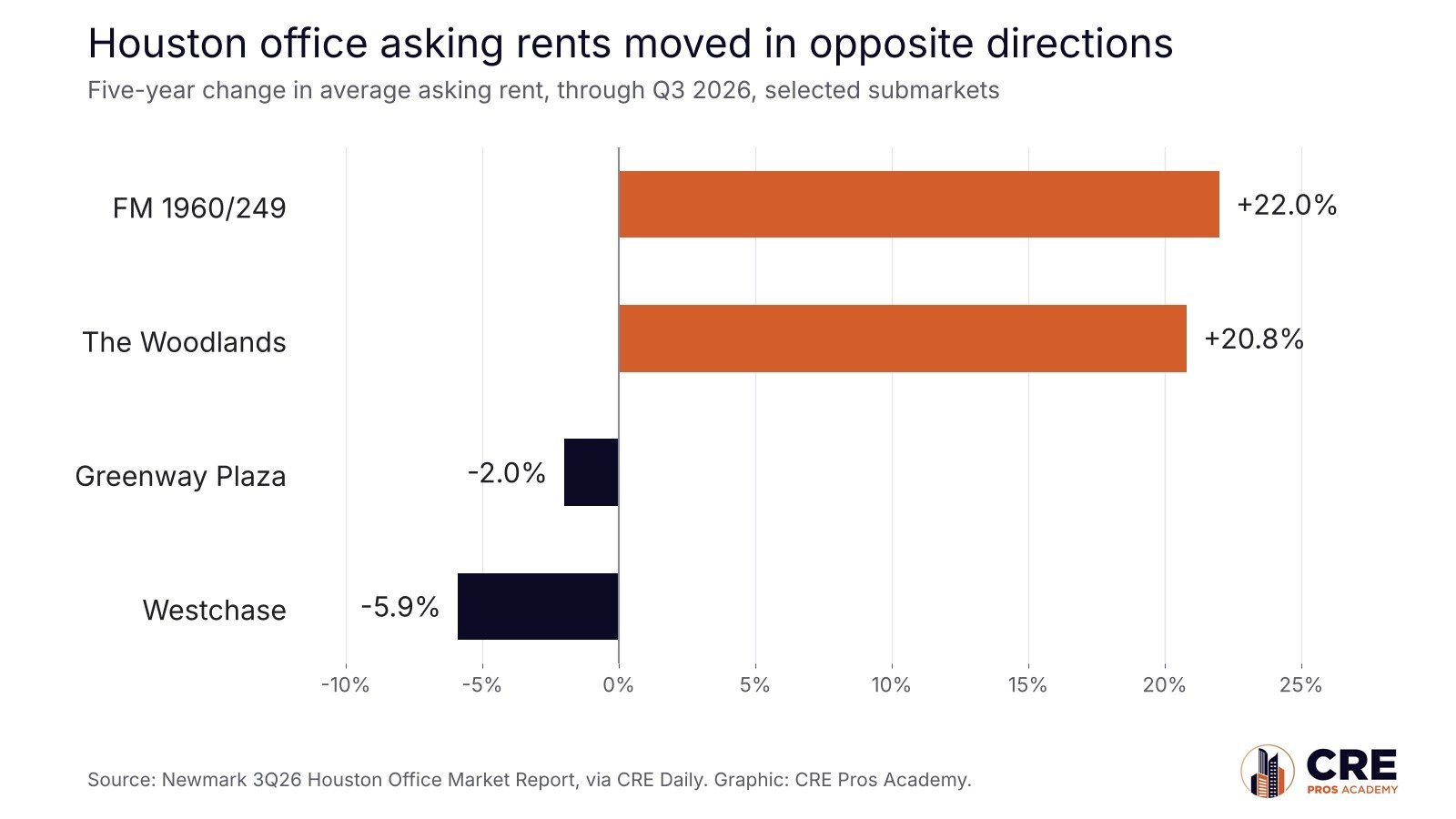
Newmark also reports average asking rents flattening near a record $31.02 per square foot, which it reads as landlords holding their headline rates while offering more concessions. Concessions are the extras a landlord gives to win or keep a tenant, such as free months of rent or a larger allowance to build out the space. A tenant who renews in place without anyone testing the market may be leaving those concessions on the table.
That kind of insight is what turns a cold call into a meeting.
Do lease expirations create landlord business too?
Yes. A landlord facing a big expiration, a vacancy or a loan coming due needs the building leased, and a broker who already knows which tenants in the submarket are in motion is exactly who that owner wants to hear from.
Trepp expects $76.6 billion in CMBS loans to reach hard maturity in 2026, with 39 percent of that volume landing in the fourth quarter. We covered why that matters for leasing in our post on rates and commercial leasing.
Decide clearly which side you represent on any given deal, and build both relationships over time.
The habit that compounds
The best expiration pipeline is not a project you finish. It is a weekly habit made up of a steady number of tenant conversations, a calendar you update every time you learn something new, and a follow-up for every date that comes into range.
Keep that habit for a year and you will know your submarket better than anyone calling it cold, and the renewal decisions in your market will start finding their way to you.
Know a commercial agent who still works off a list of old deals instead of a calendar of decision dates? Send them this.
Build a pipeline that keeps paying with CRE Pros
CRE Pros is built by two practicing commercial brokers in Houston for agents who want a repeatable system for finding and keeping commercial clients. If you are newer to commercial, start with your first 90 days in commercial real estate. Everyone teaches you how to analyze the deal. We teach you how to get one.
Eleanor & Michelle, CRE Pros Team