
For residential agents crossing into commercial ·
Your First 90 Days in Commercial Real Estate: A Plan Built Around Clients, Not Cap Rates
By Eleanor Curry and Michelle Johnson Lundy, CRE Pros
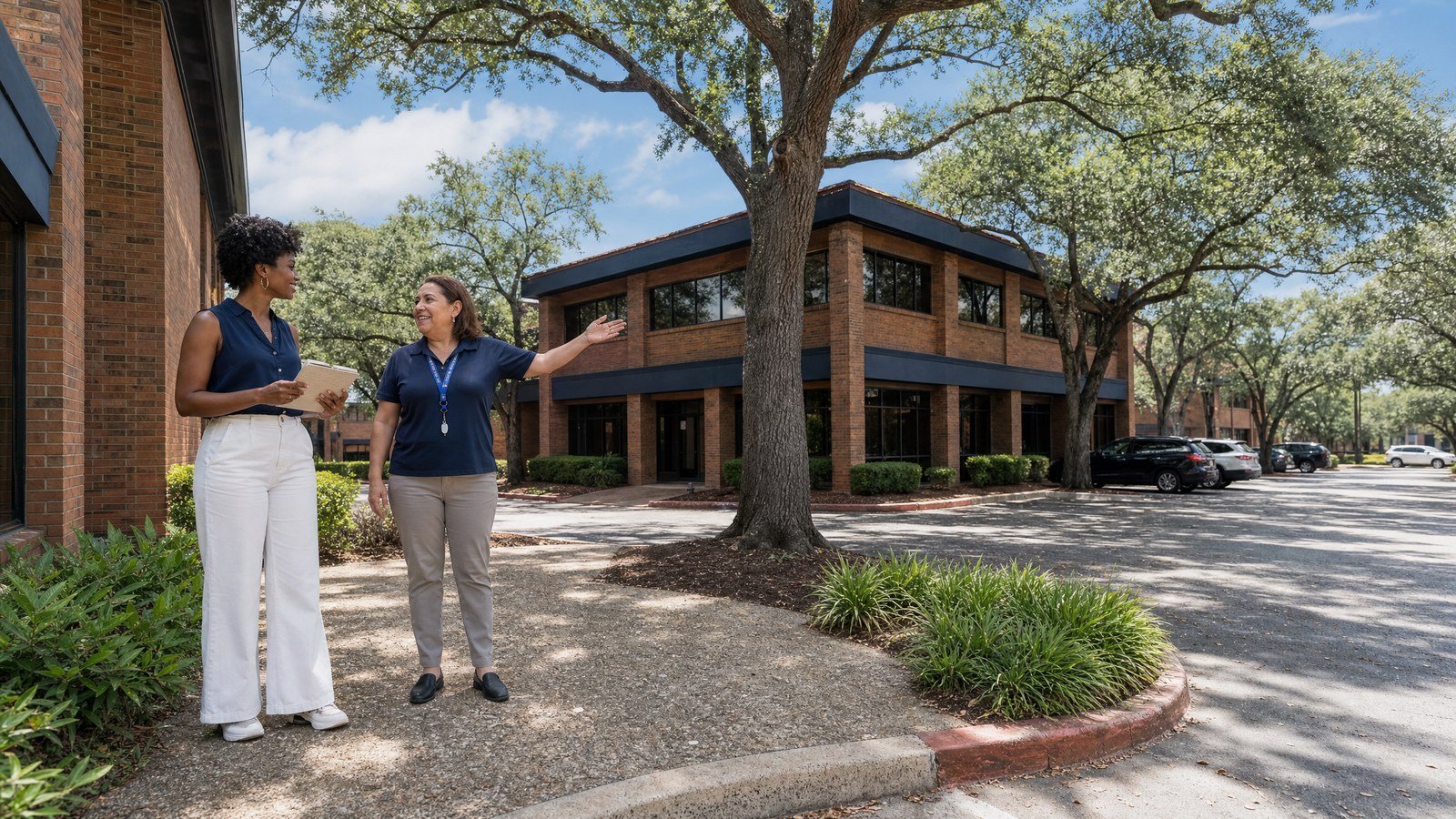
The best way to move from residential to commercial real estate is to spend your first ninety days building a pipeline of business owners, and to learn only the commercial knowledge your chosen lane requires along the way. Most agents do it backwards. They spend three months studying cap rates and net operating income, and they arrive at day ninety with a great deal of knowledge and no clients.
This plan flips that order. You will learn what you need when you need it, and you will spend most of your time on the thing that actually pays you, which is business owners who trust you with their space.
Do you need a new license to sell commercial real estate in Texas?
No. In Texas, the real estate license you already hold covers commercial transactions, so you can begin without a new one.
What you do need is a sponsoring broker who supports commercial work and, ideally, someone experienced you can call when a deal gets complicated. Commercial is learned on live deals, and nearly everyone in this business closed their first one with someone more seasoned within reach.
What should you do in your first 30 days in commercial real estate?
In your first thirty days, choose one property type and one submarket, learn the vocabulary of that lane, and list every person in your existing network who makes decisions about business space.
Commercial real estate is not one business. Office, industrial, retail and land each have their own clients, lease structures and rhythms, and trying to learn all of them at once is how new agents stay generalists with no real expertise. Pick one lane for your first year, knowing you can widen it later.
Then learn the vocabulary of that lane, and only that lane. If you choose small industrial, learn clear height, which is the usable height inside a warehouse below the lowest beam or fixture, and the difference between dock-high loading, where trucks back up to a raised door, and grade-level loading, where vehicles drive in at ground level. If you choose office, learn what a tenant improvement allowance is, which is the money a landlord provides to build out a tenant's space, and how rentable square footage, which includes a share of common areas, differs from usable square footage, which is the space the tenant actually occupies.
In every lane, you will need to know the main lease types. Here is how they compare.
| Lease type | Who pays property taxes, insurance and maintenance | Where you see it most |
|---|---|---|
| Full-service gross | The landlord, built into the rent | Multi-tenant office |
| Modified gross | Split between landlord and tenant, as the lease spells out | Office and smaller flex or industrial space |
| Triple-net | The tenant, on top of base rent | Retail and industrial |
You can learn the basics of a lane in a few weeks, and you do not need to master underwriting to represent a tenant looking for 3,000 square feet.
Houston's industrial market makes it a lane worth a serious look right now. Savills recorded 7.5 million square feet of net absorption in the third quarter, which brought the year-to-date total to more than double the same period last year. Net absorption is the amount of space tenants moved into minus the space they gave back, so a large positive number means demand is strong.
Before day thirty, also mine the network you already have. Write down every past residential client who owns a business, manages one, or makes space decisions at work. Then reach out to each of them personally, not with an announcement, but with a question: "Is your lease coming up in the next year or two, or do you know anyone whose is?"
How do you find your first commercial clients?
You find them by becoming known in your submarket between day thirty-one and day sixty, through property managers, the businesses in your lane and a steady number of real conversations each week.
Walk the buildings, introduce yourself to property managers, and ask them good questions, such as which tenants are growing and which leases roll next year. Visit the businesses in your lane and learn what they need from their space.
Set a weekly target for real conversations with business owners and decision-makers, and keep it whether or not you feel ready. Nobody feels ready for their first commercial deal, because readiness comes from doing one, not from studying for one. It comes from having a few of these conversations and realizing you were more useful than you expected.
Keep a simple record of every conversation, including who you spoke with, what their space situation is, and when their lease ends. That record is the beginning of the lease expiration calendar that will feed your business for years.
How do you represent your first commercial tenant?
Between day sixty-one and day ninety, turn a real need into a signed representation agreement, then run the search the way you ran your best residential deals.
When a conversation turns into a need, put your tenant representation agreement in writing before you start touring. A tenant representation agreement is the contract that makes you the tenant's broker and sets out how you are paid, so everyone is clear about who you represent. Ask your sponsoring broker or mentor to review that first agreement with you.
Then listen carefully, tour efficiently, negotiate hard for your client, and keep everyone informed. The skills that made you a good residential agent are exactly the skills that will close your first commercial lease.
How are commercial lease commissions calculated?
Lease commissions are commonly calculated as a percentage of the total rent over the term of the lease, and in many tenant representation deals the landlord pays the commission rather than the tenant.
Before you quote anything, confirm three things. Know the length of the term, whether there are renewal options, and whether the commission is paid at signing or at occupancy, because each of those details can change your income and your timing significantly. We explain why the term matters so much for new commercial agents in our post on commercial leasing when rates rise.
What should day ninety look like?
At day ninety you will not be an expert, and that is fine. You should have a lane, a working vocabulary, a list of business owners who know your name, a calendar of lease dates and at least one active tenant need.
Use this checklist to track it.
- My sponsoring broker supports commercial work, and I have an experienced person I can call.
- I have chosen one property type and one submarket.
- I can explain the main lease types and the core terms of my lane in plain language.
- I have listed and contacted every past client who makes business space decisions.
- I have met the property managers in my submarket.
- I am keeping my weekly conversation target.
- I have a lease expiration calendar with real dates in it.
- I have at least one active tenant need with a signed representation agreement.
That is a real commercial business in its first season, and it is worth far more than a perfect understanding of cap rates with nobody to apply it to.
Know a residential agent who has been thinking about commercial for a year? Send them this plan.
Want someone beside you for that first deal?
This is exactly what CRE Pros is built around. We are two practicing commercial brokers in Houston, and we teach the part most commercial training skips, which is how to get the client and how to handle a live deal with someone experienced beside you. Everyone teaches you how to analyze the deal. We teach you how to get one.
Eleanor & Michelle, CRE Pros Team