
For residential agents crossing into commercial ·
Interest Rates Went Up Again. Here Is Why Commercial Leasing Is Still the Best Way Into CRE
By Eleanor Curry and Michelle Johnson Lundy, CRE Pros

Commercial real estate leasing is still the best way into CRE for a licensed residential agent, even with interest rates moving up. Higher rates slow down investment sales, but businesses keep signing leases because their own calendars force the decision, and every one of those tenants needs someone to represent them.
On October 28, the Fed held its benchmark rate at 3.75 to 4.00 percent, one month after raising it in September. Two members of the committee voted for another increase, and many market watchers now see the December 9 meeting as a possible hike. If you came up in residential, you know exactly what that kind of headline does to a buyer's appetite. In commercial real estate it plays out differently, and understanding that difference is one of the first real lessons of the crossover.
Do higher interest rates slow down commercial real estate?
Higher rates mainly slow the investment side of commercial real estate, where buyers borrow to purchase buildings. Leasing slows far less, because a tenant's decision is driven by its business rather than by its borrowing costs.
When an investor finances a building, a higher borrowing cost changes what that building is worth to them, and sales slow down while buyers and sellers argue over price.
Owners are feeling it on the debt side too. Trepp expects $76.6 billion in CMBS loans to reach hard maturity in 2026, with 39 percent of that volume landing in the fourth quarter. CMBS loans are commercial mortgages pooled and sold to investors as bonds, and a hard maturity is a due date with no extension option left. An owner who needs to refinance needs a building that is full and producing income, and that is a leasing problem as much as a financing one.
Why does commercial real estate leasing keep moving when rates rise?
Leasing keeps moving because companies lease space on their own timeline. A lease expires, a company hires, two offices merge or a warehouse fills up, and the decision has to be made wherever rates happen to sit.
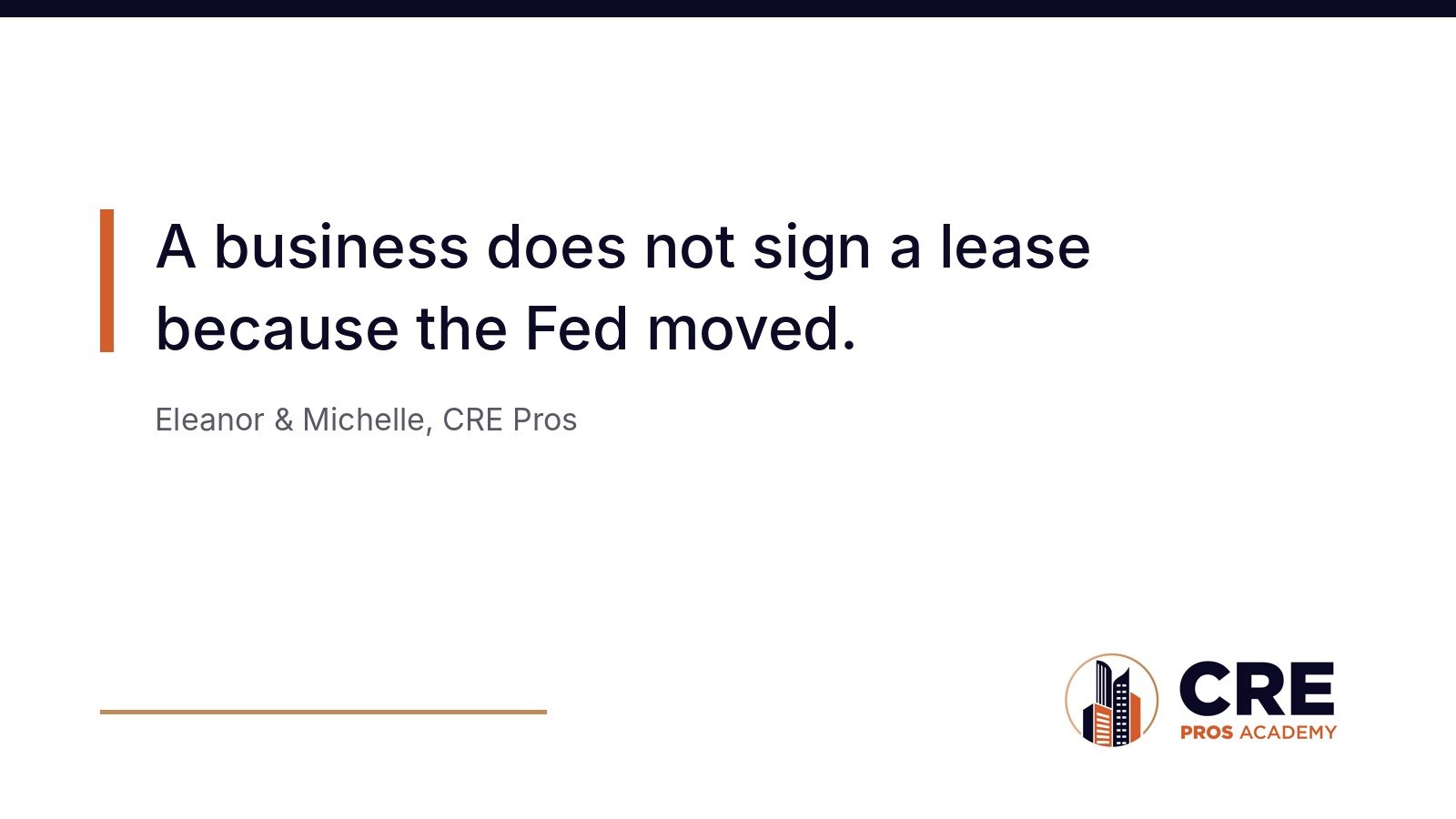
A business does not sign a lease because the Fed moved. It signs a lease because its current one is expiring, because it hired forty people, because it is folding two offices into one, or because it finally outgrew its warehouse. Those decisions run on the company's calendar, not the central bank's.
You can see that in the numbers right here in Houston. Even in a slow third quarter, Newmark counted 2.6 million square feet of office leasing, and nearly two-thirds of it went to Class A buildings, which are the newest and best-located office properties in a market. Office-using employment in the region reached a record 786,590 jobs. On the industrial side, Cushman & Wakefield reported Houston's strongest quarter of industrial leasing in more than four years.
Nationally, CompStak estimates that more than 32 percent of all office leases expire between the second quarter of 2026 and the end of 2028. Every one of those expirations is a business owner who has to make a decision, and most of them would rather not make it alone. We break down how to work that wave in our post on commercial lease expirations.
What is the quiet tailwind for new commercial agents?
The tailwind is a shortage of new space. When almost nothing new is being built, tenants who want a quality building have to compete for the space that already exists, and the tenants who start early get the best options.
Newmark reports that Houston's office construction pipeline has shrunk to a record-low 492,662 square feet, about 0.2 percent of the market and the thinnest share since 2009.
Tenants who start early usually have someone telling them to, and that someone can be you.
How do you move from residential to commercial leasing right now?
You start with tenant representation, which means representing the business that is looking for space rather than the landlord who owns it. You already have most of the skills it requires, and what you need to add is the commercial vocabulary and, more than anything, the client.
You know how to listen for what a client actually needs, how to run a tour, how to steady a nervous decision-maker, and how to get a deal to the finish line. Those are the skills that win tenant representation work.
Here is a first-month checklist you can start this week.
- Go back through your closed residential clients and write down every person who owns or runs a business. That list is the start of your commercial pipeline, and every name on it already trusts you.
- Choose one property type and one submarket, and get to know every building in it. Small office and small industrial are both forgiving places to start, and Houston's industrial demand gives you plenty to work with.
- Learn to ask the commercial version of the referral question, which is simply, "When is your lease up?"
- Write down every answer with the date it gives you, because each date tells you exactly when to come back.
For the full plan beyond the first month, read your first 90 days in commercial real estate.
Rates will do what rates do
None of us can control the Fed, and you do not need to. The agents who build a tenant pipeline now will be established and trusted when investment sales pick back up, and many of the owners who eventually buy buildings started out as tenants who trusted someone with their lease.
The crossover is not about waiting for perfect conditions. It is about getting your first commercial client while everyone else is still reading the headlines.
Know an agent who keeps saying they will try commercial once rates come down? Send them this.
Get your first commercial client with CRE Pros
CRE Pros is built by two practicing commercial brokers in Houston for licensed agents who want a clear path to their first commercial client. Everyone teaches you how to analyze the deal. We teach you how to get one.
Eleanor & Michelle, CRE Pros Team